
Nobody gets excited about master data.
Nobody wakes up thinking, “Today’s the day I fix our vendor duplicates!” And yet, if there’s one thing that quietly decides whether your next ERP upgrade, BI rollout, or AI project succeeds, it’s this.
Here’s a scenario we hear versions of all the time.
A mid-size distributor decides to roll out a shiny new analytics platform. Leadership wants a single view of customer profitability. The project kicks off. Three months in, the dashboards are built, and the numbers look… off. One major customer shows up as four separate accounts because sales, finance, and two regional warehouses each created their own record over the years. Revenue is split across all four. Profitability looks terrible for some versions, amazing for others. The CFO doesn’t trust any of it.
The project gets paused for a “data cleanup phase” that nobody budgeted for.
This is why industry coverage of ERP trends keeps pointing to fragmented master data as a core problem. When different business units each maintain their own version, you get a siloed data landscape that undermines analytics and reporting. And now, with agentic AI starting to take actions based on that data, the stakes are even higher. A dashboard with bad data is misleading. An AI agent with bad data is dangerous.
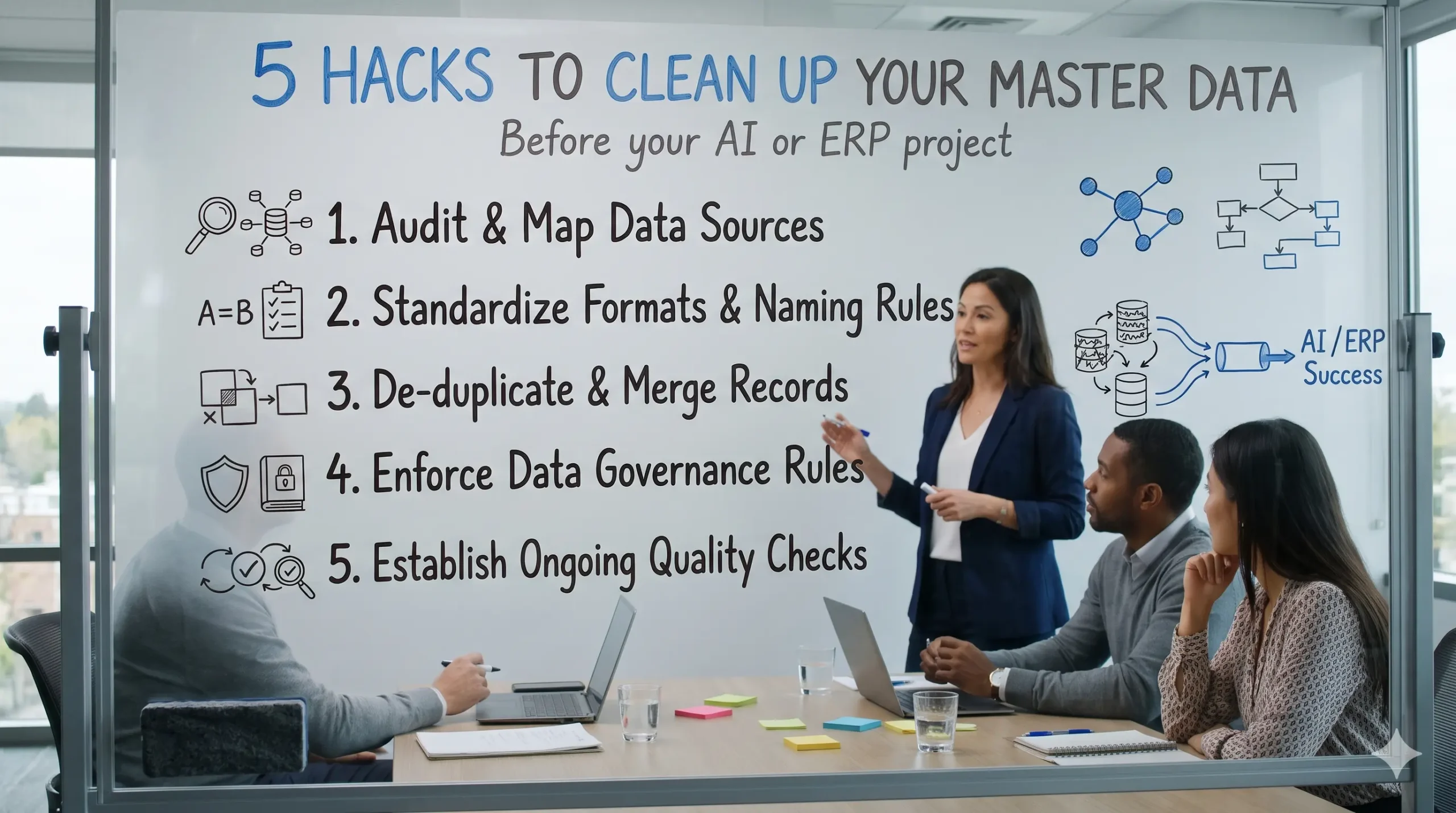
So let’s get practical. Here are five hacks you can start this week, even without a big budget.
Hack 1: Start with the data that costs you money, not the data that’s easiest to fix.
Most cleanup projects fail because they try to fix everything at once. Don’t. Ask a simple question: where does bad data cause real pain? Duplicate vendors can lead to duplicate payments. Wrong customer addresses cause failed deliveries and invoices that never get paid. Outdated product pricing erodes margin.
Pick the one domain where errors hit the bottom line most directly. For many businesses, that’s vendors (payment risk) or customers (revenue and collections). Fix that first. The quick, visible win also earns you support for the next phase.
Hack 2: Run a “duplicate hunt” with simple matching rules.
You don’t need fancy software to find most duplicates. Export your vendor or customer list into a spreadsheet and sort by:
- Tax ID or registration number
- Bank account details (for vendors)
- Phone number
- Email domain
- A cleaned version of the name (remove “Inc,” “LLC,” “Ltd,” punctuation, and extra spaces)
You’ll be amazed how many duplicates jump out within an hour. “Acme Corp,” “ACME Corporation,” and “Acme Corp.” with the same tax ID are the same company. Merge them, and pick one golden record.
Hack 3: Assign an owner to every data domain.
This is the hack that makes all the others stick. Data gets messy because nobody owns it. Sales creates customers, finance edits them, operations adds shipping addresses, and no single person is accountable for whether the record is right.
Assign one owner per domain. One person for customers, one for vendors, one for products, one for employees. They don’t have to do all the data entry, but they approve new records and changes, and they’re the one people go to when something looks wrong.
It sounds like bureaucracy. It’s actually the cheapest data quality investment you’ll ever make.
Hack 4: Lock the front door with required fields and simple validation.
Cleaning existing data is pointless if bad data keeps flowing in. Look at how new records get created in your ERP, CRM, or accounting system. Then tighten the gates:
- Make key fields mandatory (tax ID, country, payment terms, category).
- Use dropdowns instead of free text wherever possible.
- Add a duplicate check at creation (most modern systems support this).
- Restrict who can create new vendor records, especially, given the fraud risk.
Every bit of friction you add at the front door saves hours of cleanup later.
Hack 5: Make a monthly 30-minute data health check a ritual.
Put it on the calendar. Same day every month. The data owners pull a few simple reports:
- New records created this month (spot-check 10 for accuracy)
- Records with missing key fields
- Potential new duplicates
- Records not used in 12+ months (candidates to archive)
Thirty minutes, once a month. That’s it. Data quality isn’t a project with an end date. It’s a habit, like brushing your teeth. Skip it for a year and things get painful.
Bonus hack: celebrate the cleanup publicly.
Data work is invisible. When it’s done well, nothing happens, and nobody notices. That’s exactly why it gets deprioritized. So make it visible. When your vendor owner merges 140 duplicate records, share the number in the team meeting. When the customer owner fixes the addresses that were causing failed deliveries, show the drop in returned shipments. A tiny bit of recognition turns data stewardship from a chore into a point of pride, and that’s what keeps the monthly ritual alive after the initial enthusiasm fades.
Why this matters more in 2026 than ever.
We’re entering a phase where business software doesn’t just store and report data, it acts on it. Agentic AI in ERP is projected to be a huge growth area through 2030, according to Gartner. Those agents will match invoices, reorder stock, and route approvals based on whatever is sitting in your master data. If that data is a mess, you’re automating chaos.
The flip side is exciting. Companies that clean up now will be first in line to actually benefit from AI features as they roll out. Clean data is the ticket to the party.
At B2B Flux, we cover the big shifts in ERP, BI, and enterprise operations every week, but we always try to bring it back to practical steps like these. Because strategy is only as good as the foundation underneath it.
Your takeaway: This week, pick one data domain. Spend one hour on the duplicate hunt in Hack 2. Count how many duplicates you find. Share that number with your leadership team. Nothing builds the case for data quality like a real number.
Now tell us: what’s the messiest data in your business right now? Customers, vendors, products, or employees? Drop it in the comments, and we’ll put together specific fixes for the most common answers in a future post.