
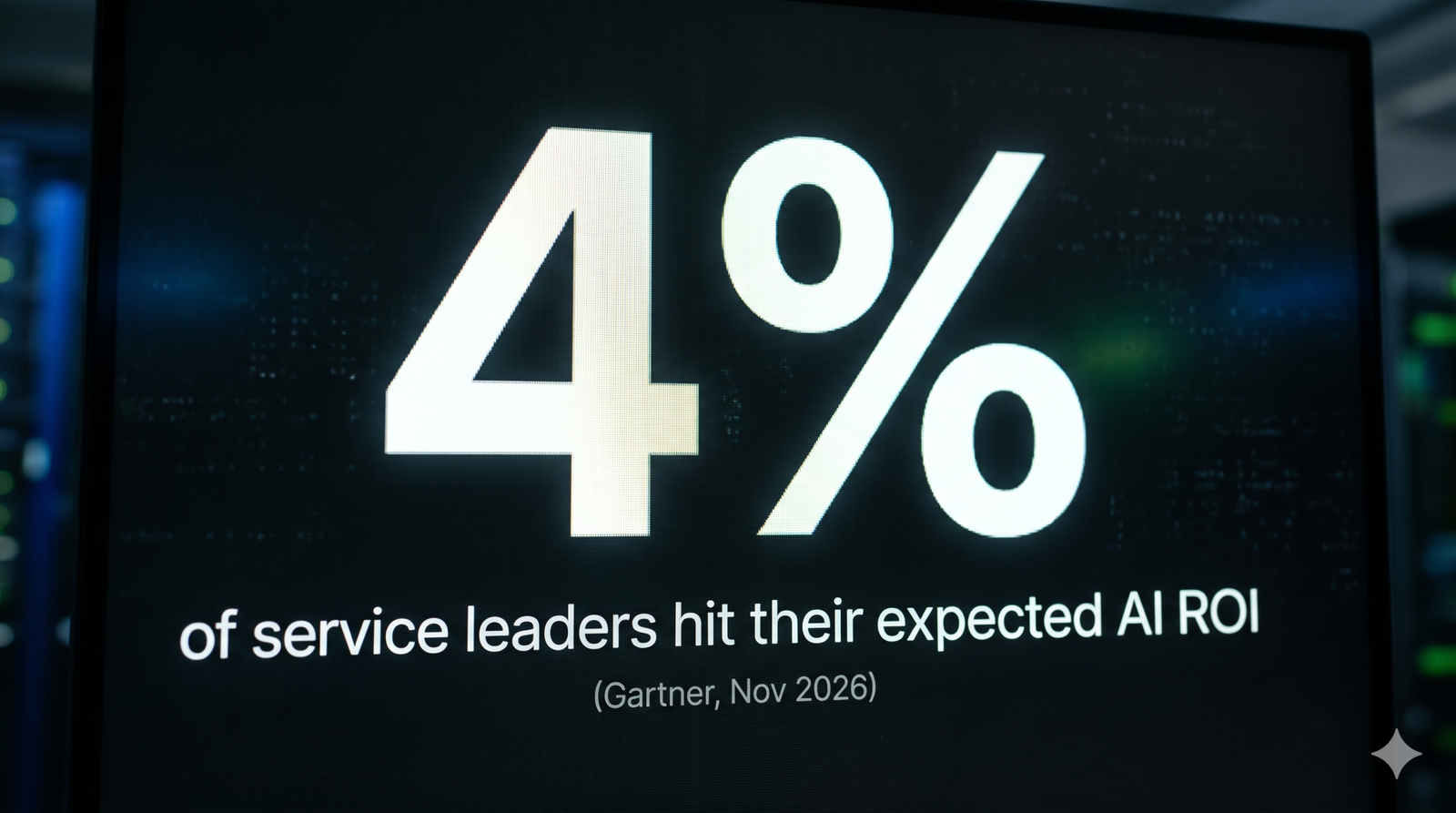
Four percent.
That’s the number that stopped us mid-scroll this month. In a survey published in November 2026, Gartner found that just 4% of customer service and support leaders say they’ve achieved the ROI they expected from their AI initiatives.
Not 40%. Not 14%. Four.
Now, before anyone panics and cancels their AI pilots, let’s slow down. Because that number isn’t really a story about AI failing. It’s a story about how most of us are buying AI.
Let me paint you a picture you’ve probably lived through.
It’s a Monday leadership meeting. Someone from the board forwarded an article about a competitor “deploying AI agents across operations.” The CEO turns to the room: “Where are we on AI?” Nobody wants to be the person who says “nowhere.” So by Friday there’s a budget line, a vendor shortlist, and a pilot with a catchy name.
Six months later the pilot technically works. The chatbot answers questions. The forecasting tool spits out forecasts. The dashboard is beautiful.
And nothing has actually changed about how the business runs.
The support team still escalates the same tickets. Finance still rebuilds the forecast in a spreadsheet because they don’t trust the model. Sales still ignores the lead scores. The tool is live. The value isn’t.
Sound familiar?
Here’s what we keep seeing when we dig into the research and the conversations happening across enterprise teams right now.
1. AI is being bolted on, not built in.
Gartner has been pretty blunt about this: organizations often implement AI in customer experience piecemeal, creating disconnected projects instead of a coordinated transformation. That’s true well beyond customer service. ERP, HR, project management, accounting… the pattern is the same. A tool gets added on top of a process that was already broken, and then everyone is surprised when the broken process runs faster.
AI doesn’t fix a messy workflow. It amplifies it.
2. Nobody defined “value” before the project started.
Ask ten teams what their AI pilot was supposed to achieve and you’ll get answers like “efficiency,” “insights,” or “innovation.” Those aren’t goals. Those are vibes.
The teams that land in the 4% tend to start with one boring, specific metric. Average handle time. Days to close the books. Time-to-hire. Forecast accuracy within a set range. If you can’t name the number you’re moving, you can’t prove you moved it.
3. The data underneath isn’t ready.
This one hurts, because it’s the least glamorous part of the job. Most mid-size and enterprise companies are running multiple versions of the truth. Different business units maintain their own master data. Customer records don’t match between the CRM and the ERP. Product codes drift.
Then we hand that to an AI model and ask it to make decisions.
There’s a reason analysts covering ERP trends keep circling back to master data and fragmented data landscapes. It’s the foundation. Skip it, and every AI layer you add is built on sand.
4. The people side is treated as an afterthought.
Here’s a stat worth sitting with: ADP’s research found that 85% of small businesses still want a human involved when they use AI tools. That’s not resistance. That’s people telling you how they want to work.
When AI rollouts ignore that, adoption quietly dies. People route around the tool. They keep their spreadsheets “just in case.” The license renews, the usage doesn’t.
So what do the 4% do differently?
From everything we’ve read and heard this year, it comes down to a few habits.
They start small and painfully specific. One process, one team, one metric. Not “AI for operations,” but “cut invoice exception handling time by 30% in accounts payable.”
They fix the process before they automate it. If a human can’t explain the workflow on a whiteboard in ten minutes, an AI agent definitely can’t run it.
They budget for the unsexy stuff. Data cleanup, integration, training, change management. These often cost more than the software itself, and the teams that plan for that up front don’t get blindsided at month six.
They keep humans in the loop by design. Not as a fallback, but as part of the workflow. AI drafts, humans decide. AI flags, humans investigate. Trust grows, and so does usage.
And they measure relentlessly. Before and after. Every month. If the number isn’t moving, they change course quickly instead of defending the project because someone’s reputation is attached to it.
Here’s the part we find genuinely encouraging.
Gartner also says customer service leaders are under intense pressure to implement AI, with 91% feeling that pressure in 2026. Pressure plus a 4% success rate means the gap between companies that figure this out and companies that don’t is about to get very wide, very fast.
That’s an opportunity if you’re willing to be a little more deliberate than everyone else.
You don’t need the biggest AI budget in your industry. You need the clearest problem statement, the cleanest data you can manage, and a team that actually wants to use the thing.
At B2B Flux, this is exactly the kind of gap we want to help close. Every week we dig through the research, the analyst predictions, and the real-world chatter across ERP, BI, HR, finance, and operations, and we translate it into what it means for people actually running businesses. No hype. No vendor fluff. Just the signal.
Your takeaway for this week:
Pick one AI initiative you have running right now. Ask three questions:
– What exact number is this supposed to move?
– What was that number before we started?
– Who on the team actually uses this every day, and what do they think of it?
If you can’t answer all three, you’ve just found your next priority. And honestly, that’s a win, because now you know where to focus.
We’d love to hear from you. Has your company’s AI spend paid for itself yet? Drop a “yes,” “no,” or “nobody’s measuring” in the comments. No judgment, we promise. Most of us are somewhere on that list.